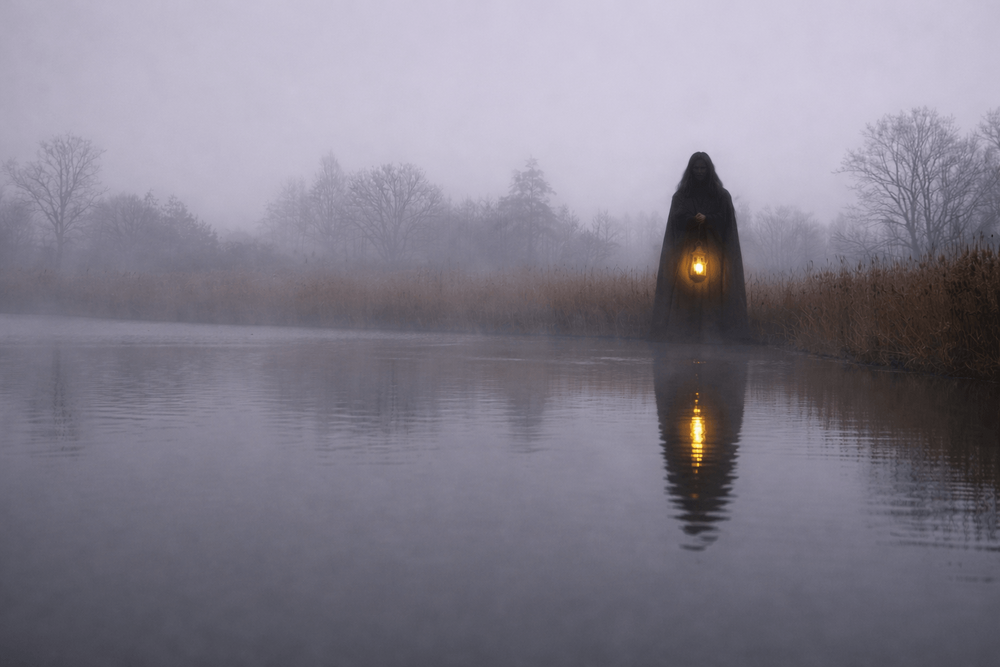
The Gatekeeper of the Vilt
In Beugen, they still talk about Mare. Not because it is a beautiful story, although that is true too, but because it really happened. Or at least because everyone who has seen it swears that it really happened.
Mare was not someone you noticed easily. She walked around in the same brown dress, always with mud under her nails. She lived in a small hut on the edge of the fen, where the reeds begin and the village ends. Her husband had drowned years ago; everyone knew that. She had no children, only the swamp.
She knew every place where you could sink. Every ditch where your foot could get stuck. Every place where the water was deeper than it seemed. People came to her when their cow had disappeared, or when a child had run too far into the field. They didn't pay her. Sometimes they gave her bread or a few eggs. Mare accepted it or not, depending on her mood.
She never said much. She looked at the water, pursed her lips, and then, with her little yellow lantern, just walked in one direction. Sometimes with big strides, sometimes foot by foot. Sometimes she turned around halfway and went back. “Not today,” she would say. “The pond isn’t in the mood.”
The people thought she was crazy. But their cows and children came back. So, logically, they kept asking her for help. On the night of the storm—that was in '47 or '48, nobody remembers exactly—two boys from the smallest farm walked into the reeds. Stupid boys. They wanted to bet who could go the furthest. They weren't careful that day, or on any other days for that matter.
When they did not return, the village gathered. Armed with torches, loud voices, and a lot of noise, they set off. Mare stood by and watched. She said nothing. The men wanted to enter the pond, but Mare grabbed the mayor's arm.
“This isn’t going to work,” she said. “Let me do it.”
That was all. No explanation, no warning, just the words: that isn't going to work.
She walked into the pond. Alone. It was dark and it was still raining. The village was waiting. That was the worst part, the waiting. The mother of one of the boys wasn't even crying. She just stood there, with her arms crossed, staring at the reeds.
Towards morning, the boys finally returned. They were completely soaked. Their clothes were torn. They were chattering their teeth and could barely speak. But they were still alive.
“Mare walked ahead of us,” said one of the boys. “We couldn’t see her very well, but we heard her feet and saw the silhouette of her lantern. So we followed that. She said we had to be quiet. That we weren’t allowed to say anything. So we kept silent.”
The next day, the parents wanted to thank Mare. They went to her little hut. It was empty. Not empty like someone who has moved. But empty, as if someone had disappeared. Her things were still there: a cup on the table, a scarf on a chair, but Mare was gone, along with her lantern.
They searched for her, but in vain; they found nothing. Since then, people say that Mare stayed in the fen.
Now, when you walk through De Vilt early in the morning, when it is still grey and quiet, some people feel something. Not necessarily scary. Something… cautious. As if someone is checking if you are being respectful.
The people who trample the reeds, who scream, who are not careful, they lose their way. And very occasionally, when the water is very still and the mist hangs just above the reeds, people see a silhouette on the other side.
The people of Beugen say that it is Mare. That she is still checking. That she is still making sure everyone is careful. That she is protecting the fen. They don't say it because they know for sure. They say it because they feel it.
And if you walk through De Vilt early in the morning, you feel it too.